Tuesday, May 27, 2025

Midnite Sun, triple-registered Palomino Morgan

Midnite Sun

Among the materials from the estate of Monrovia/Duarte rancher Merle Little were documents and photos related to one of his best-known stallions, the Palomino Morgan, Midnite Sun. 

Bred by Merle, Midnite Sun was by Sun Down Morgan:

And out of Dawnglo:


Foaled in 1943, Midnite Sun was something of a rarity in his day: a triple-registered Palomino Morgan. 

There were two active Palomino horse registries in the 1940s: the Palomino Horse Association (PHA) and the Palomino Horse Breeders Association (PHBA). Merle registered Midnight Sun in both, in addition to his Morgan Horse Association registration. 

Merle saved his PHA registration form.


Merle corresponded with the Morgan Horse Club about Midnite Sun and Dawnglo in 1944:


This photo was taken by John Williamson, who captured many of Merle's horses on film during the 1940s-early 1950s. 


Merle took out ads for Midnite Sun in the Western Livestock Journal, and there are other photos of him in the estate collection.


This photo is by Lucille Stewart. 


Photos of some of Midnite Sun's offspring were also in Merle's estate. Here's El Tesoro (Palomino, 1952, x Ojo del Fantina):


Ezra Morgan (chestnut, 1952, x Betty Joaquin, pictured with her colt):


And Rocky Morgan (Palomino, 1949, x Anita Belle Gift):


We'll never know for sure, but I wonder if Rocky Morgan was named after Merle's friend Allan "Rocky" Lane, the cowboy actor who played "Red Ryder" in Western films?  The first mentions we see of Merle Little and Rocky Lane in local newspapers are from 1949, when Merle recruited the actor and his movie horse, the black Morgan stallion Anndy Pershing (whose stage names were "Thunder" -- Red Ryder's horse -- and "Black Jack") to take part in the annual Fiesta de Duarte. Merle served as the Fiesta chairman of the Duarte Chamber of Commerce. (Duarte and Monrovia are neighboring communities; Merle's El Rancho Poco straddled both.)

This article and the accompanying photo appeared in the Monrovia News-Post, June 7, 1949.


"Prize Arab Horses": The Importation of Arabians from the Middle East for William Randolph Hearst, 1947-1948

 In August 1947, several American newspapers carried a short article on the start of the journey of three men to the Middle East to acquire Arabian horses for media mogul William Randolph Hearst's ranch in San Simeon, California. The three were ranch manager Preston Dyer, Jr., photographer John Williamson, and veterinarian Dr. Fred Pulling. 


(The Santa Barbara News-Press spelled "Hearst" wrong.
He didn't own the paper.)

Theirs was a very long journey. It wasn't until May 16, 1948 that Hearst's own publication, the San Francisco Examiner, reported on the return of the Dyer party with 


This Hearst stallion was registered as *Ghamil 4217.
The caption said that he was "titled 'Jamil.'"

The paper added a photograph of Hearst's best-known Arabian stallion, Ghazi 560. The "greatest of Arab stallions" was, according to the caption, "welcoming kin to his new home with neigh." 


Ghazi 560 


* * * 

Photographer John Williamson was a grandson of American cereal millionaire W. K. Kellogg. More on his life can be found in the W. K. Kellogg Arabian Horse Ranch Records, 1910-1949, part of Special Collections and Archives, University Library, Cal Poly Pomona. (I ran the search for you, below.)

Saturday, April 19, 2025

Plover Says "Bonjour"

My regular readers know that there's not much I love more than a good estate sale, antique store, or yard sale with horse stuff in it. But sometimes we don't have to rescue used horse-related stuff -- we just have to appreciate it.

Recently I went to an estate $ale in Brentwood (West Los Angeles) that I knew for sure I could not afford. But I did want to at least go by the sale and say hello to Plover in person before it was too late.


The Thoroughbred horse Plover (foaled 1839, by Royal Oak x Destiny, by Centaur) was the subject of a painting by English artist Thomas Woodward (1801-1852). Owned and registered in France, Plover was renowned as the winner of the 1842 French Derby (Prix du Jockey Club); the artist Woodward was a friend of Benjamin West and Edward Landseer.


From British Racing Prints, 1700-1940, by Charles Lane.
Source: Internet Archive.

British newspaper accounts of the day tell us that Plover's owner, the Comte Edouard de Perregaux, commissioned the portrait after Plover's big win. His portrait was framed in Paris, and the small plaque on the front, in French, gives his short history.


Sadly, Plover was reported to be unsound after the race, and I can't find much more information about him.

But wasn't he handsome?


Plover's owner at the time of his win, M. le Comte, was a member of Le Jockey Club de Paris, but is better remembered for his interesting personal life than for his race horses. If you look him up online, you'll see that the Count was briefly married to the courtesan Marie Duplessis before she left him for the novelist Alexandre Dumas the younger. He, in turn, fictionalized her as Marguerite Gautier in his novel La Dame aux Camelias. Later, Giuseppe Verdi turned the story into his opera "La Traviata." After she left Dumas fils, Duplessis seems to have become the love interest of composer Franz Lizst before she died young, yes, of tuberculosis.

Plover's portrait was priced at much more than my 2024 tax refund, so I had to leave him there for someone else to buy. I hope Plover ends up in a good home where someone will appreciate him, hopefully in a public museum where more people can appreciate him, and Woodward's artistry.
But, in case he does fall off the public radar, at least we have a photo of our old friend Plover to appreciate and enjoy.


Photos of the painting by the author. Certain images in this post may be provided under the Fair Use provision in Section 107 of the United States Copyright Act. "Fair Use" specifically allows for the use of copyrighted materials for educational purposes only.

Sunday, February 16, 2025

Betty Joaquin and "Tuffy Morgan" = Hagen-Renaker "Nancy" and "Tony"

Hagen-Renaker "Tony" newborn foal and "Nancy" mare

Equine history and the history of model horse figurines often overlap. This is, I believe, the case for the mid-20th century Morgan mare Betty Joaquin and her 1953 foal, known as "Tuffy Morgan," and the ceramic mare and foal figurines called "Nancy" and "Tony" by the California pottery Hagen-Renaker, Inc. 

In the 1950s, Hagen-Renaker was located in Monrovia (Los Angeles County), California. So were Betty Joaquin and Tuffy Morgan. They belonged to horse rancher Merle Little (1906-1975). 

Betty Joaquin and her 1953 colt

The artist who designed "Nancy" and "Tony," Maureen Love (1922-2004), spent many hours visiting Merle's El Rancho Poco on Mountain Avenue in Monrovia, sketching horses on the property, and observed at a distance by Merle, his family, and his employees. 

Artist Maureen Love

I believe that Betty Joaquin and her 1953 foal, which Merle's daughter Marlene called "Tuffy Morgan," inspired the H-R "Nancy" and "Tony."

Hagen-Renaker "Nancy" and "Tony."
These examples were originally owned by Merle Little.

The figurines were some of Maureen's earliest horse designs for H-R, issued in Fall 1955 to Spring 1957, Spring 1958, 1964, and 1965. "Nancy" and "Tony" came in matte grey with darker shading.  (It was common for Hagen-Renaker to mass-produce horse figurines in colors other than the color of the real horse Maureen Love sketched and then turned into a 3D design.)

Some collectors have identified "Nancy" and "Tony" as Thoroughbreds or horses of unknown breed, but the Hagen-Renaker factory's handwritten Mold Book identifies them as Morgans. 

Source: Hagen-Renaker Mold Book, courtesy of Nancy Kelly

I also believe they are Morgans, because Merle Little's older daughter, Marlene, told me that her father's Hagen-Renaker "Nancy" model was based on Betty Joaquin. 

Merle kept many photographs of his prize-winning mare Betty Joaquin. Foaled in 1940, she was bred by the "dean of Morgan horse breeders," Roland Hill. Her sire was Joaquin Morgan and her dam was Dan's Betty. Betty Joaquin was well known in regional horse show arenas. 

Betty Joaquin and Merle Little

Four of Merle Little's Morgan mares at a horse show in San Diego.
Betty Joaquin is second from left.

This first-person testimony, and the notation in the Mold Book that "Nancy" and "Tony" were Morgans, is borne out by photographs of Betty Joaquin and her 1953 foal. Marlene said that she called him "Tuffy Morgan," but her father called him by another name (she didn't say what).


Merle Little owned two Hagen-Renaker "Nancy" models and one "Tony." The two mares show some of the variations in Hagen-Renaker's decorating styles.


They also demonstrate how good Maureen was at capturing the body language of a mare with a very young foal at her side. The mare's attitude seems to change, depending on which side of her you're on.

Betty Joaquin had several registered Morgan offspring, and there are photographs of at least two more of them as foals from Merle Little's estate. (More on them in separate blog posts.) But I believe the foal known as Tuffy Morgan probably inspired the H-R "Tony." 

Look at little Tuffy Morgan's head...


..and compare it to that of the Hagen-Renaker "Tony."


There's other evidence. Back in 2013, many of Maureen Love's original sketches of horses were sold by her heirs on eBay. Ed Alcorn archived the eBay photos on his Hagen-Renaker Online Museum website. At least one of them appears to show Betty Joaquin and a foal.


Source: Hagen-Renaker Online Museum

This photograph, from Merle Little's estate, shows Betty Joaquin's long forelock, mane, and tail.


I believe that it's at least plausible that Betty Joaquin and her foal known as "Tuffy Morgan" inspired the Hagen-Renaker "Nancy" and "Tony" Morgans. 

The sad part of this story is that there's no record of Tuffy Morgan, or any 1953 foal out of Betty Joaquin ever being registered. It's possible that he didn't survive; it's possible he was half-bred and sold without being registered. 

At least we have Maureen Love's record of him, in the form of the Hagen-Renaker "Tony" newborn foal.


Photographs of real horses and people are from the estate of Merle Little. Model horse photographs are by the author. Certain images in this post are provided under the Fair Use provision in Section 107 of the United States Copyright Act. "Fair Use" specifically allows for the use of copyrighted materials for educational purposes only.

___________________________________________

You can find the Hagen-Renaker Mold Book on Hagen-Renaker historian Nancy Kelly's website: 

https://ketain.com/hagen-renaker-mold-book/

The Hagen-Renaker Online Museum is here:

https://hagenrenakermuseum.com/

This is Brenda L. Tippin's article on Roland Hill, in The Morgan Horse magazine:

https://www.morganhorse.com/upload/photos/904TMH_AprilMay2018_HISTORICAL_RolandHill.pdf

You can see Betty Joaquin's pedigree here:

https://www.allbreedpedigree.com/index.php?query_type=horse&h=BETTY+JOAQUIN&g=5&cellpadding=0&small_font=1&l=

All Breed Pedigree, above, says she was a silver dapple, but her registration papers say she was dun. 


And this ad in Western Livestock Journal, from 1943, shows that her previous owner described her as "chocolate brown, with a white mane and tail."

It's helpful to remember that, back then, horse owners and breed registries didn't have the same understanding of equine genetics and color that we do now. A good resource for horse color information is author Lesli Kathman's website:

https://www.horse-color.com/about

Monday, January 27, 2025

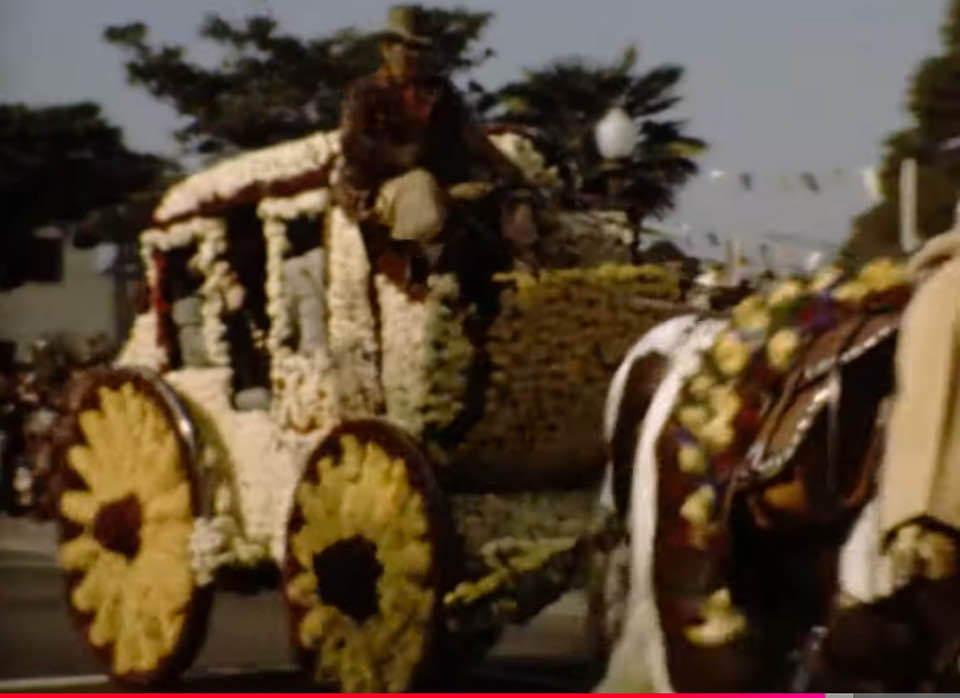
The Arrow Rock Stage Line Stagecoach in the 1948 Tournament of Roses Parade

The behind-the-scenes stories of the annual Tournament of Roses Parade are too numerous to count. But because Monrovia/Duarte horse rancher Merle Little saved his family's photo album and paper ephemera, we have some examples of just how connected the local equestrian community was to the Parade, in the years before and after World War II. 

On the backs of three snapshots, Merle wrote "R. P. 1948" in pencil.

Merle rode his Morgan stallion, Senor Morgan (standing next to the horse van) in an equestrian unit in the Fifth Division of the parade.


And Merle saved a photograph of his handmade stagecoach, decorated with flowers and bearing the logo of the Weber Bread company, which was based in what we now call Southeast Los Angeles. 

This video on YouTube shows the Weber's Bread entry decorated in white, yellow, and red flowers, in the 1948 Rose Parade, staring at 12:03:

https://www.youtube.com/watch?v=84fgOI0IAT0

We can also see Merle's stagecoach in this ad that Weber's Bread took out in the January 16, 1948 editions of the Los Angeles Times and Pasadena Independent. 

Los Angeles Times, January 16, 1948


Merle Little and Montie Montana were good friends, and took part in many Southern California equestrian activities together over the years. 

The captions tell us the names of the humans (though unfortunately not the Pinto horses) that took part in the parade. On the left of the group shot, we see the members of the 1940s-50s iteration of the cowboy singing group Riders of the Purple Sage and their leader, Foy Willing. (This Western singing group was founded in 1942, as opposed to the New Riders of the Purple Sage, founded in 1969 and featuring members of the Grateful Dead.) 

The people on horseback were Montie and Louise Montana and two executives from Weber's Bread, Vee Bear and Roy Nafziger. The larger, main photo in the ad shows Nafziger, rodeo performer Jess Kell, who drove the stagecoach, and Montie Montana.

Merle Little would have been up ahead in the parade, aboard Senor Morgan.

Here's Merle's stagecoach without the flowers. In this photo, Merle and his wife, Edna May, and their daughters Donnette and Marlene. The stagecoach is drawn, as it usually was when Merle drove it, by Merle's Morgan mares Santa Ynez (with the blaze) and Anita Belle Gift (with the star).


The story of how Merle came by his stagecoach is worthy of its own blog post, which I'll share soon.

____________

Here's the Historic Los Angeles page for Weber's Bread: 

https://hpla.lacity.org/report/aca422f3-bc22-47f5-aacf-69e0f52a05fb

The newspaper ad noted that Foy Willing and the Riders of the Purple Sage had a radio program on KNX. You can hear a selection songs by Foy Willing and the Riders of the Purple Sage here: https://www.youtube.com/watch?v=-ZqAcjn87yU

And here's their Wikipedia page: 

https://en.wikipedia.org/wiki/Riders_of_the_Purple_Sage_(band)


Monday, September 23, 2024

East Visits West: Earl Krantz of the United States Morgan Horse Farm in California, Autumn 1946


Morgans at El Rancho Poco, Monrovia/Duarte, California,
probably in the late 1940s to mid 1950s.

In February 1947, The Morgan Horse Magazine published an article by Earl S. Krantz, then head of the United States Morgan Horse Farm near Middlebury, Vermont.  He called it "Morgan Travelogue." (I'll put a link to an archived copy of  the entire issue of the magazine at the end of this post.)

Krantz detailed his Autumn 1946 trip across the United States, visiting Morgan horse breeders in Vermont, Illinois, Kansas, and California, "and a few en route," and commenting on their horses. Krantz outlined the reasons for his travel on behalf of the Morgan Horse Club:

When he got to Southern California, Krantz mentioned the Morgan horses being bred by:

Mary Smith, Camarillo

Dr. C. C. Reed, Compton

Dr. Leonard J. Brunie, Pasadena

Keith Morse, Arcadia

Hugh Logan, Glendale

O. C. Foster, Calabasas

E. W. Roberts, Los Angeles 

Merle Little, Monrovia/Duarte

Krantz spent a couple of paragraphs describing the activity of the Morgan Horse Association of the West, which had 75 active members. Krantz reported that when the group met in November 1946, 60 members who owned about 400 registered Morgans were in attendance.

"For the first time in Morgan history all major and many minor bloodlines are being gathered into one area in sufficient numbers of make possible greater selective breeding," Krantz wrote. "Even though the interests of these breeders may vary in the use of Morgan saddle horses for pleasure, for parade, for stock or ranch purposes, a blending of bloodlines is sure to be made with greater uniformity of type and usefulness."

In Merle Little's estate collection is a photo of Krantz visiting Merle in Monrovia/Duarte. I'm not sure if this has ever been published before. 

A rubber stamp on the back of the 8x10" original shows that Merle had called upon one of the best-known horse photographers in the area of that day, John Williamson, to document Krantz' visit.


From left to right: Earl Krantz; Cal Secrest, on an unidentified Morgan (note the hackamore bridle); Merle Little; Merle's stallion Senor Morgan 8647.

The young Cal Secrest (who, I believe, worked at El Rancho Poco), wrote a note accompanying the photograph: "Merle was very proud!! of this visit by Mr. Krantz. I [Cal] was 17 years old in this picture."

* * *

Here's the entire issue in PDF form:

https://www.morganhorse.com/upload/photos/7671_February1947TMH.pdf