Thursday, July 18, 2024

More Than Harness Racing: Some Other Equestrian Events at Devonshire Downs, Northridge, California, 1947-1959

(San Fernando) Valley Times, 8 May 1947

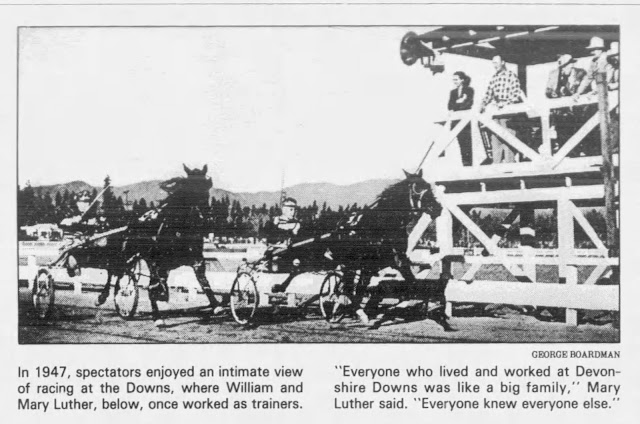
In our continuing look at the very "horsey" place that Southern California used to be, we turn our attention to a stretch of land in the San Fernando Valley known as Devonshire Downs.

In 1943, equestrians Helen Dillman and Lee O. "Pete" Spears bought 80 acres of land at Devonshire Street and Zelzah Avenue in the San Fernando Valley to develop a harness racing track. A shortage of materials and labor during World War II delayed the project; the US Army used the property as a dispatch depot for military supplies until the end of the war.

The 4 April 1946 issue of the Van Nuys News and Valley Green Sheet reported that Mrs. John McCarthy of Los Angeles had purchased the property in 1945, and Spears was managing the development of the land for the equestrian facility. (Like so many suburbs in Los Angeles County, Granada Hills and Northridge were cheek-by-jowl with one another back then.)


By March 1947, plans were being made for a "horse show and harness race meet" on the property. 15,000 people were expected to attend. 

Valley Times, 20 March 1947


Van Nuys News and Valley Green Sheet, March 27, 1947

We often hear of Devonshire Downs as a venue for harness racing, but it's important to remember that it hosted many kinds of equestrian activities. 

A few months after its opening, the Arabian Horse Breeders Society of California sponsored its third annual Arabian Horse Show, under the direction of Cecil Edwards.


Pomona Progress-Bulletin, September 3, 1947


The show was promoted in newspapers and horse magazines.  The horse in the photo insert is Sharik, the Arabian dressage horse. 


The horse in this photo insert is *Lotnik, who had been imported to Southern California along with *Witez II and many other horses captured from the Nazis in Europe at the end of World War II. The painting of *Lotnik is by Gladys Brown Edwards. 


Over the next decade, Southern California's population continued to grow, and many local residents took riding lessons, participated in horse shows and parades, and enjoyed equestrian events at Devonshire Downs. Here's the San Fernando Valley Fair program from 1956. 

Valley Times, 29 August 1956

The Lipizzaner Dressage Performance at the 1956 show featured Cilly Feindt and her Lipizzaner Pasha. They are a key feature of my earlier blog post on the "dancing white horses" of Southern California (link below).


In October 1956, the nearby Granada Hills Chamber of Commerce hosted a "Fall Round-Up" at Devonshire Downs. It featured a free Western horse show, music, and "bar-b-q."


Valley Times, 5 October 1956

In 1957, the venue hosted a gymkhana in May, and the West Hills Hunt Club's two-day National Horse Show in June. Around Labor Day, 100,000 people were expected to attend the San Fernando Valley Fair at Devonshire Downs over its five-day run. That year's Fair featured daily equestrian events, including horse shows, harness racing, rodeos, and "cowboy racing."


Newspaper accounts reported that, by 1959, 100 Thoroughbreds, Standardbreds, and show horses in training were stabled at Devonshire Downs. The 1959 West Hills Hunt Club National Horse Show raised funds to help send the US Olympic Equestrian Team to the 1960 Olympics in Rome.

Valley Times, 10 June 1958.

Many online accounts of horses at Devonshire Downs focus on harness racing there, often with a mention of Quarter Horse racing. Standardbreds that raced in Northridge during the spring season would move to Bay Meadows in San Mateo (San Francisco Bay Area) because there were no other opportunities to race in Southern California at the time until the Los Angeles County Fair in September.

But the times, as they so often do, were changing. By the late 1950s, the Valley Times newspaper was reporting on concerns that "advancing urban development" would crowd out the San Fernando Valley's long history as an agricultural area. 

In the early to mid-1960s, harness racing was starting to be featured at Santa Anita in Arcadia and at Hollywood Park in Inglewood. Purses for races there were described as "rich." But by 1968, Devonshire Downs was the last remaining track offering harness racing in Los Angeles County, according to the Los Angeles Times. 

Sidebar: If Devonshire Downs is remembered for one thing -- for most people, even more than than its equestrian history -- it is for the June 20-22, 1969 "Newport '69 at Devonshire Downs" festival that featured an unbelievable number of famous, and soon-to-be-more famous, musicians.  This was held about two months before the Woodstock festival in New York. 

Los Angeles Times, June 8, 1969

Jimi Hendrix, Santana, Marvin Gaye, Eric Burdon (and his "new band, War"), Joe Cocker, Ike & Tina Turner, Taj Mahal, Jethro Till, Creedence Clearwater Revival, The Rascals, the Byrds, Three Dog Night, Booker T & the MGs, Johnny Winter, Buffy Saint Marie, Steppenwolf, Poco, Friends of Distinction, the Edwin Hawkins Singers, and others performed. 
A three-day pass cost $15.  

Newport '69 at Devonshire Downs was big, noisy, very crowded, and not without its problems. Newspapers across the country, while praising some of the performances, concentrated their coverage on police arrests of gate crashers, the cost of repairing the damage to nearby property incurred during the festival, the number of people taken to the hospital for injuries, and the amount of trash left behind by concert-goers. [End sidebar.]


Ownership of the property changed several times over the years, and by 1971, Devonshire Downs was owned by Valley State College (now Cal State Northridge). The school chose not to continue to pay for a facility that could not "pay for itself."  

The last horse left Devonshire Downs in May 1971. The land is now the north end of the Cal State Northridge campus, covered in dormitories and various businesses.

More details are in the 27 October 1985 Los Angeles Times' article on the history of Devonshire Downs. 


***

The Los Angeles Public Library collection holds a number of photographs of activities at Devonshire Downs.

https://tessa2.lapl.org/digital/collection/photos/search/searchterm/%20Devonshire%20Downs

Materials on the early days of the Arabian Horse Society of California are in the Cecil and Gladys Brown Edwards papers at the W. K. Kellogg Arabian Horse Library at Cal Poly Pomona:


Here's my blog post on Lipizzaners in Southern California:


Moving from horses to Hendrix, here's a link to Rolling Stone magazine's coverage of Newport '69: 

https://www.rollingstone.com/music/music-news/crashers-cops-producers-spoil-newport-69-120810/

There are several old films of Newport '69 archived on YouTube. Here are a couple; it's easy to search for more.

https://www.youtube.com/watch?v=mvPx_YhWqc4

https://www.youtube.com/watch?v=bRpArDH9MCE


Tuesday, July 16, 2024

Misty's California Connection (with an Arizona footnote)

Horses have a way of inspiring us and bringing us together for our own common good, and for theirs. This is the story of how four women, three of them members of  the "greatest generation," came together to inspire and create an special piece of equine art and history. (And in a footnote, we'll add a fifth person to our list of people who helped keep Misty's story alive.)

The three older women were author Marguerite Henry, artist Maureen Love, and Maxine Renaker, co-founder of the California pottery Hagen-Renaker, Inc. The fourth was Maxine's daughter, Susan Renaker Nikas. And the little horse that brought them together was Misty. 

With Marguerite Henry's exciting story and charming illustrations by Wesley Dennis, the 1947 book Misty of Chincoteague became an instant classic that is still enjoyed by children (and adults) today.

In real life, Marguerite bought Misty as soon as she was weaned, and Misty accompanied her on some of her travels to make public appearances and speak to children, librarians, and teachers after the book was published in 1947. 

Marguerite Henry and Misty
(via Wikipedia, Fair Use)

After eleven years of touring, Misty retired to the Beebe Ranch on Chincoteague Island where she became a broodmare. She died peacefully in her sleep in 1972, at the age of 26.

The story of the real-life Misty of Chincoteague has been well-documented, online and at the Museum of Chincoteague. Model horse collectors are very familiar with the many versions of "Misty" and her equine family produced in plastic by Breyer. Through books, museum exhibits, YouTube videos, websites, and horse figurines, Misty's story lives on to inspire more generations of children and adults who love horses.

What some fans of Misty may not know is that, twenty years after Misty passed away, her continuing story developed a California connection. In my papers are letters, beginning in mid-1992, that shed light on the development and 1993 distribution of the Hagen-Renaker, Inc. ceramic "Performing Misty" designed by Maureen Love and retailed by Breyer.

An early version of the Hagen-Renaker "Performing Misty"
in front of a photograph of Marguerite Henry riding the real Misty.
Photo by the author.

The design by Maureen Love shows Misty in her iconic "shaking hands" pose, with one hoof planted on a five-legged wooden stool, similar to more than one of Wesley Dennis' drawings of Misty.

The letters came from my late friend, Susan Renaker Nikas, who along with her parents John and Maxine Renaker, was running the Southern California pottery in the early '90s. 

In July 1992, Susan wrote:

Dear Teresa,

...I have no doubt that we will have samples on "Misty" by December as we are in the process of making the master mold for them this week...but they will not  be released until January 1993.

In September 1992, I received an update on the H-R "Misty." Maureen Love's design had been turned into a three-dimensional mold, decorated (painted), and fired. Maxine Renaker had taken a sample "Misty" to Marguerite Henry at her home in Rancho Santa Fe (San Diego County), California:

I just thought I would let you know about the latest development with the "Misty Saga." My Mom took the test Misty over to Marguerite Henry last week...She said it was the best reproduction of Misty she had ever seen....

(O, to have been a mouse in the corner at that historic meeting!)

On December 1, 1992, Sue wrote:

I met Marguerite Henry this weekend and she is an absolute charmer! She certainly doesn't act like someone in her nineties. I had talked to the guy from [Breyer] Reeves International and Misty is definitely coming out in '93. I have shipped them an additional 40 pieces which they wanted for their sales meeting.

One of the side notes to the "Performing Misty" story is that the piece was first issued with the horse's leg attached to the stepstool, but Hagen-Renaker was forced to ship the two pieces separately because of breakage. Sue's March 1993 letter to me provides the details:

...We have had a lot of breakage on Misty and are now shipping the stool separately so that the retail customer will have to glue it on. (They were all breaking right where the stool was on the foot so we tried shipping them separately and only one was broken out of 41. We had shipped 198 and had 41 broken on the previous shipment.) I guess they are selling well because Breyer has ordered 1000.

As with so many other things in life, timing is everything. The Hagen-Renaker "Performing Misty" was released by Breyer in 1993. Within eleven years, Marguerite Henry, Maxine Renaker, and Maureen Love would all pass away. 

A nice example of the "Performing Misty" was sold from Maureen Love's estate in 2005. A photo of it, taken from the eBay listing, appears on the Hagen-Renaker Online Museum website. Note the rich color and sharply defined edges on the spots.

After she wrote to me about the "Performing Misty," Susan very kindly gave me another of the early figurines. Although it is not marked as such, the hand-painted decoration of this model leads me to believe that it is not a regular production run piece but an early piece created before the rest of the run was issued through Breyer.

Here's the piece in my collection. Note the color of the spots (this is accurate to the piece itself) and the shading on the mane and legs. (When I received her, one of the stool's five legs was damaged, but the other four legs still support the piece perfectly.)

Photo by the author

Here is a regular-run "Performing Misty," from the Hagen-Renaker Online Museum website. She's very pretty, but her pinto pattern is a different color and is not painted and shaded in the same way.

Source: Hagen-Renaker Online Museum

Although I'll always have a soft spot for the Breyer "Misty," I do think that Maureen Love's sculpt looks more like the real Misty herself. 

Though she will never be as famous as her real-life namesake, my little "Performing Misty" is accustomed to public appearances. In 2018-2019, she appeared in the outstanding exhibit "Miniature Menageries: The History and Artists Behind Hagen-Renaker, Inc." at the W. K. Kellogg Arabian Horse Library, which is part of the Special Collections unit at the Cal Poly Pomona University Library. 


***

In addition to the Hagen-Renaker connection, we can add another female member of the "greatest generation" to the enduring story of Marguerite Henry and Misty of Chincoteague. 

Arizona artist Hildred Goodwine (1918-1999)

Arizona equine artist Hildred Goodwine (1918-1998) became friends with Marguerite Henry and, in 1990, issued a series of six prints showing Misty in various settings. The series was labeled "In memory of Marguerite Henry's MISTY OF CHINCOTEAGUE."  Here's one of them:


I met Hildred a couple of times at model horse events in the Phoenix area. She, too, was an "absolute charmer," and very enthusiastic about sharing her love and knowledge of horses.

***

If you haven't read Misty of Chincoteague, or haven't read it in years, perhaps it's time to revisit it, and/or the other horse books you enjoyed as a child. As C. S. Lewis said, “No book is really worth reading at the age of ten which is not equally – and often far more – worth reading at the age of fifty and beyond.” 

A montage of Misty by Wesley Dennis

You can read about Misty's real, and fictional, life at the website Misty's Heaven. "Breyer's Misty Family" is one of the links on the website. You can click on it to see all the various iterations of Misty and her relatives in miniature form:

https://www.mistysheaven.com/historyofmisty.html

The Museum of Chincoteague Island produced a video on the story of Misty. It's available on YouTube:

https://www.youtube.com/watch?v=4KiTIuUVvjs

And the Museum's website is here:

https://chincoteaguemuseum.com/

With its special model horse hobby connections, the Misty of Chincoteague Foundation website is here:

http://www.mistyofchincoteague.org/about/

The website for artist Wesley Dennis is here:

https://www.wesleydennis.com/

The feature film "Misty" can be seen here:

https://www.youtube.com/watch?v=dpDJqho2KpQ


After Susan Renaker Nikas passed away in 2022, the Hagen-Renaker factory in Southern California was shuttered. Now, Kristina Lucas Francis' Hagen-Renaker Tennessee continues the legacy as the exclusive licensee for new Hagen-Renakers:

https://www.facebook.com/p/Hagen-Renaker-Tennessee-100057139552584/

W. K. Kellogg Arabian Horse Library:

https://libguides.library.cpp.edu/wkkahl

The Art of Hildred Goodwine group on Facebook is a good resource:

https://www.facebook.com/profile.php?id=100049489011279

Here's my blog post on the "Miniature Menageries" exhibit:

https://modelhorsehistory.blogspot.com/2019/12/miniature-menageries-history-and.html

And my blog post on Hildred Goodwine:

https://modelhorsehistory.blogspot.com/2021/04/bring-tradin-stock-model-horses-of.html


Certain images in this post are provided under the Fair Use provision in Section 107 of the United States Copyright Act. "Fair Use" specifically allows for the use of copyrighted materials for educational purposes only.


Friday, July 5, 2024

Remembering Marwyck Ranch

Illustration of the house at Marwyck
from the September-October 1937 issue of The Horse magazine.

Twentieth-century horse magazines are an essential part of my equine history research. Leafing through the September-October 1937 issue of The Horse magazine, I recently found an article that connects directly to my recent visit to what remains of the Thoroughbred breeding farm first known as "Marwyck." This ranch, near the corner of Devonshire and Reseda in Northridge, was established by Marian and Herbert "Zeppo" Marx and Barbara Stanwyck. 


The article was written by Robert Ordway Foote (1883-1959), well-known as literary editor for the Pasadena Star-News and author of articles in a variety of nationally-distributed magazines ranging from The Rotarian to Esquire.

Marian Marx and Barbara Stanwyck were good friends. The trainer at Marwyck was professional horseman Harry S. Hart.

Barbara Stanwyck,
San Francisco Examiner, December 31, 1938

Herbert "Zeppo" Marx,
Los Angeles Times, August 23, 1932

Marian Marx, Harry S. Hart, and an unidentified Thoroughbred.
Los Angeles Times, January 25, 1937

That a serious Thoroughbred breeding establishment would be owned by celebrities might have struck some of Robert O. Foote's readers as unusual.  The Horse was published by the American Remount Association and its target audience was probably serious horse breeders, owners, and riders. 

So in the dry style characteristic of his work, Foote begins the article by explaining that the new Marwyck Ranch in Southern California was the result of a predictable pattern that was common in Hollywood:

Movieland, in its craze for horses, displays the same inclination to quick change in taste that marks all its other activities, from clothes to domesticity. What the stars see reflected in the horse life around them, they at once imitate.

Foote uses examples of film stars who, during the heyday of cowboy movies, "went in extensively for range horses and ranches out in the wilds of Los Angeles County.

"Then came the American country life picture and along about the same time a great awakening of horse show interest in Southern California. The result was that every featured player [in the movies] had to have his own saddle-horse.

"Polo intruded on the screen and, in getting atmosphere, the movies found they were located close to one of the leading polo clubs in America -- Midwick." Foote mentions celebrity polo players including Will Rogers, Walt Disney, and studio head Jack Warner. He then turns to horse racing. 

"Thoroughbred racing did a come-back all over the country and the movie colony found a new spot in which to put some of its easy money. It went in for racing stables and men like Bing Crosby, who has backed a new track at Del Mar, near San Diego..."

Note: In 1933, California had legalized parimutuel betting; subsequently, Santa Anita racetrack opened on Christmas Day, 1934. It's less than 40 miles away from the Marwyck property.

Foote describes Marwyck Ranch as "a very de luxe commercial project."

"Marwyck -- the Mar comes from Zeppo Marx, the brother who already has forsaken the famous theatrical act to become an agent of other performers. The Wyck comes from Barbara Stanwyck, lovely screen star, whose agent Zeppo is. They bought 320 acres out in the Fernando Valley, north of Los Angeles, and put in a real horseman to establish for them a stud farm, for thoroughbred horses, for breeding, training, boarding -- but not, Hollywood learned with astonishment, for hiring out horses [to the movies]." 

(The property was actually either 120 or 130 acres, depending on which source you use. Stanwyck and Marian Marx kept their horses at the Los Angeles County Fairgrounds stables in Pomona until the stables at Marwyck were completed.)

The caption for this photo in The Horse reads: "Harry S. Hart,
manager of Marwyck Ranch, photographed with a Marwyck foal."
The magazine did not identify either horse.  


Foote continues:

"Harry S. Hart, a noted Kentucky horseman, was put in charge and he has created in the short space of less than a year a farm which, with allowance for the sort of elaboration which Hollywood gives everything, will nevertheless in its fundamentals be really worthy of the Bluegrass."  

Foote's description of the property shows that the planners were forward-thinking about life in Southern California. He writes about the horse barn's "earthquake-proof stalls, together with automatic fire-sprinkling equipment... The ranch already has large training and breeding barns, uses outdoor feed sheds in order to take full advantage of the all-year salubrious California climate. The hay-storage above the barns is arranged with wire-netted sides, to keep out all pests yet allow free circulation of air and guard against spontaneous combustion.... On the ranch lands where grazing fields are rapidly assuming green texture, a portable sprinkling system has been devised, a highly important matter in the irrigated West." 


The caption in The Horse magazine reads "Breeding Barn at Marwyck Ranch."
Again, the horses are not identified. 

Foote describes the half-mile training track, complete with starting gate, and continues:

"The whole aim of Hart has been to provide the cleanest, most sanitary surroundings possible. With 56 horses on the place, two months after opening, he had no a single sick animal, he declared. There are a dozen or so yearlings and as many foals; the rest are alder horses, headed by The Nut, a noted sire. The Nut is a big bay by Mad Hatter [sired by Fair Play, who sired Man O' War] - Afternoon, by [Prince] Palatine, and during his career as a handicap horse won $100,470... Several of his get will be brought to the racing at Santa Anita next winter."

Another Marwyck stallion not mentioned in the article was the handicap and stakes-winning Saxon (foaled 1924, Broomstick x Homely). The Los Angeles Evening Citizen News' March 22, 1937 edition provided the names of some of the original Marwyck mares: Sun Lady and Best Lady, recent purchases from Arizona; Clouds, and Princess Megan.


The Los Angeles Times' January 14, 1937 edition gives us details on some of the horses at Marwyck:


Returning to the article in The Horse magazine, Marx and Stanwyck were not the only celebrities associated with Marwyck. Foote writes:

"Robert Taylor, latest idol of film fans, is one of the owners who keeps his equine hopes at Marwyck Ranch. Mrs. H. R. Fairbanks, noted horsewoman, has several there and Mrs. W. H. Furst, daughter of Mrs. Ethel Mars of the Milky Way Stables, is also represented in the stock on the grounds." (Yes, Mars as in Mars chocolate.}

(Taylor and Stanwyck were married in 1939, and divorced in 1951.)

Foote gives credit where credit is due to Harry S. Hart. He many years' experience at Thoroughbred farms in Kentucky, but his roots were in California:

"He came to [Marwyck] from years of success with La Mar Stock Farm at Lexington, the Thistleton Farm at Frankfort, the Swingalong Stables and other noted Kentucky stables. Though still in his early forties he dates back in California experience to the original Lucky Baldwin Santa Anita track of 30 years ago, where he was an exercise boy. He has brought many strings of racers to the California tracks, to old Caliente, to newer Bay Meadows, and lately to Santa Anita...

"Incidentally, Hart's experience has given him a conclusion which he is willing to pass along to other trainers from the East. It is that to success in California racing, they must ship in from 30 to 45 days in advance of racing, in order to acclimate their stock. Either that or race immediately after arrival, he declares. In between, the animal cannot do his best."

Foote concluded with a description of Stanwyck's house on the property:

"Upon a sightly [pleasing to the eye] hill overlooking all the activities of Marwyck Ranch are arising two huge structures, typical motion picture 'cottages.' One of them is a reproduction of an Irish dwelling, only this one has 20 or 30 rooms; it is to be the home of Miss Stanwyck. The other reproduces the house which made a beautiful set in the film 'Maytime;' it will be the family home of Zeppo Marx."

The former home of Barbara Stanwyck, now known as the Oakridge Estate.
 Photo by the author, June 30, 2024.

Marwyck made its own feature film debut with the 1940 release of "Sporting Blood," starring Robert Young, Maureen O' Sullivan, and Lewis Stone, known to film audiences as Mickey Rooney's father in the popular "Andy Hardy" films. Ironically, the film is about horse racing in Kentucky.

Fort Worth Star-Telegram, July 17, 1940

Several California newspapers reported that the racing scenes in "Sporting Blood" were filmed at Santa Anita (also not in Kentucky). Thoroughbreds in the film were played by the Marwyck horses Brown Hills and Playboy, according to another press report:

Greenville, Alabama Advocate, September 12, 1940

Stanwyck's house was purchased in 1941 by actor Jack Oakie, who renamed it Oakridge. The later history of the Marwyck Ranch property will have to be the subject of another blog post. I'll put links to this history at the end of this post, so you can get a head start.

Cutting to the chase, of the gracious Thoroughbred ranch that was Marwyck, only ten acres including the house remain. Thanks to the efforts of a city councilmember and a dedicated team of volunteers, the property is now a Los Angeles City Historic Cultural Landmark, owned by the City of Los Angeles Department of Parks and Recreation. The Stanwyck home is, slowly, being restored after years of neglect. And there's a public park on the property.

Over time, the horses, the barns, the race track, and the Marx home all vanished as fortunes and interests changed, owners passed away, and the open lands and pastures that had so long characterized the San Fernando Valley were swallowed up by the needs of an ever-increasing population. 

Today, much of the Southern California landscape can appear as a blur of hot concrete, asphalt, and metal as we rush by to whatever comes next in our story since the horse was crowded out of the scene and exited the stage.  

For most people, the stories of the horses of Marwyck Ranch are now just a whisper, a hoofnote in a larger story of suburban expansion. But it's still important to remember that horses were, and are, an integral part of the story of the San Fernando Valley, and their role in Los Angeles County history must not be downplayed or ignored.

***

Many thanks to Patricia LoPresti for providing me with background information on Marwyck, and to the Friends of Oakridge volunteers who provide informative guided tours of the house for the public.

The Oakridge Estate is Los Angeles City Historic Cultural Monument #484. You can read a summary of its history here:


A YouTube video documents the 2020 dedication of Oakridge Park on the property. It's adjacent to the Stanwyck house:


Architects Robert Finkelhor and Paul Revere Williams are both associated with Oakridge. The outstanding Paul R. Williams Project website speculates that, since Finkelhor was the architect of record in 1937, he designed the house for Stanwyck, and that later, Williams made renovations and additions for Jack Oakie sometime after Oakie bought the property in 1941:

"During the 1930s Paul Williams had designed a number of celebrity estates in the Northridge area but not the Stanwyck or Marx homes. Robert Finkelhor’s name is listed as architect of record on the original building permit on file with the City of Los Angeles. (1937) Before her death Victoria Oakie wrote a series of books celebrating her husband’s life and their shared love of Oakridge. In these books she often cited Paul Williams as their personal architect. (Victoria included a photo of Williams viewing her home after the Northridge Earthquake.) 

"It is speculated that Williams provided designs for a series of renovations and additions to the property during the Oakies’ lives. A rendering of the house with Paul Williams’ name can be found in the Jack Oakie papers housed at the American Heritage Center at the University of Wyoming. The notation F.A.I.A. (Fellow American Institute of Architects) is included with the drawing, a designation Williams received and used after April 1957. Further research is needed to determine the totality of Williams’ connection to the house."


A Barbara Stanwyck fan website provides additional details on the Marwyck Ranch when the actress owned it:


The Classic Hollywood Central website includes a photo of Barbara Stanwyck and Robert Taylor on their ranch:


A trailer for the 1940 MGM film "Sporting Blood" (not to be confused with the 1931 Clark Gable film of the same name) shows scenes filmed at Marwyck Ranch and other locations. The sound quality is not great. It looks like you can see Marwyck at about 23 seconds in. It's not much, but it's something:


The Museum of the San Fernando Valley website includes some information on Northridge Farms:


This May 13, 1985 Los Angeles Times article describes the gradual selling-off of the property:


Robert O. Foote's Esquire article "Who Was Joe Miller?" showed his gift of writing humorous stories, somewhat in the style of Robert Benchley, James Thurber, and P. G. Wodehouse. You can read it here:

https://classic.esquire.com/article/1942/1/1/who-was-joe-miller

Foote's biography, which he doubtless wrote himself, reads:

Robert O. Foote confessed that, having progressed from reporter to managing editor before he was thirty, he settled on that traditional journalist sinecure: sports-writing. But even the best-laid plans of sports-writers go awry, and one day Foote was caught reading a book -- apparently so amazing a cultural activity in a sports-writer that he was made literary editor of the Pasadena Star News.

Foote has other activities more or less nefarious. He was a political correspondent for newspapers on the Atlantic seaboard, and he once made a decent -- or, at least, a soft -- living as a pulp-writer. His favorite hobby is browsing among the musty volumes in the Huntington Library, one of California's noblest literary monuments, and it was there he obtained the scholarly background for his examination of "Joe Miller" and his sources.