Saturday, April 20, 2024

Part One: Some Arabian (and Not Really Arabian) Horses in Silent Films, 1921-1926

Historically, the motion picture industry has been good at telling exciting tales that also reinforced cultural, ethnic, racial, and gender stereotypes. Some of the films mentioned in this blog post may fit that description.

But the horses working alongside the actors and film crews didn't know about stereotypes; they were just doing their jobs. 

This story is about the horses.
_____________________________________________________________________________

Some Arabian (and Not Really Arabian) Horses 
in Silent Films, 1921-1926
Part One


Rudolph Valentino and the Kellogg Arabian stallion Jadaan
in "The Son of the Sheik."
Valentino played two parts in the 1926 silent classic,
The Sheik and The Son of the Sheik.
Jadaan was the older character's mount.


Around the turn of the 20th century, most Americans had never seen a purebred Arabian horse in person or on film; there just weren't that many of them spread across the country at the time. They might have seen paintings in a museum, or photographs and Homer Davenport's drawings of the Arabians he imported to the United States in a newspaper.

But to the entertainment community, and many Americans, a horse was "an Arabian" because someone said it was. There was just something about the words "Arabian horse" that nineteenth and early 20th century entertainment promoters loved. 

(And indeed, horses themselves don't assign breed names to themselves. That's the result of geography, domestication, selective breeding, and humans deciding that certain horses are called by a particular breed name because of their parentage, color, size, and so on, often establishing a breed registry to keep some horses in and others out of the bloodlines.)

Around the time the first motion pictures were made, pop culture purveyors used the term "Arabian" as a synonym for "exotic-looking horse," "trick horse,"  "horse in a costume," or sometimes "white (or black) (or spotted) horse under saddle or pulling a chariot." The "Arabian" could be a fancy horse n a stage production, a circus, an equestrian event, or a silent film. It didn't necessarily matter if the horse was, demonstrably, what breeders of the time would have called a purebred or even a part-bred Arabian.  

The first Arabian horses with Middle Eastern bloodlines were brought to the United States in the early 1700s, with a few subsequent importations throughout the 19th and early 20th centuries. Until the Arabian Horse Club was established in 1908, there was no recognized way to register your Arabian horse in this country.

Rutland, Vermont Weekly Herald, 11 June 1908

Volume 1 of the Arabian National Stud Book, published in 1913, shows only a little over 100 registered Arabians in the United States. 

But silent films of in the 1920s boasted hundreds of horses promoted as "blooded Arabians," "steeds of the desert," "Arab chargers" and the like. Hollywood back then was big on movies featuring so-called "Arabian horses," but producers usually brought in other kinds of horses, or horses whose Arabian ancestors were never written down, to play the part of Arabians. 

Usually, but not always. 

In this series, we'll look for purebred Arabians in silent films in the 1920s. We'll review a two (yes) examples of purebred Arabians in the US that appeared in films; one film lost, one film preserved. We'll discuss a few silent films that were shot in the Middle East, Israel, Algeria, and Egypt, that used local horses. And we'll see a couple of examples of silent films with other breeds of horses that, demonstrably, had Arabian ancestors -- but they weren't Arabians themselves. 

Unfortunately, many silent films have been lost to time, and it isn't always easy to find still photographs of the horses in those films, so we can't see what those "Arabians" really looked like. 

We'll start with a quick look at the most famous Arabian of the silent film era: W. K. Kellogg's stallion Jadaan 196 (196 is his American registration number).

***
Jadaan was indeed one of the best-known and most beloved Arabian horses between the First and Second World Wars. Although Jadaan sired 21 purebred Arabians, he is best remembered as "the horse that Valentino rode" in the star's last film, "The Son of the Sheik." Rudolph Valentino (1895-1926) was wildly popular at the time, and when he died suddenly a few months after "Son of" was released, Jadaan was promoted as "Valentino's horse."

Renowned Arabian horse authority Carol Woodbridge Mulder knew Jadaan personally. She remembered:

"Jadaan was one of the most important horses in the history of the Kellogg Ranch. He became, probably, the best known Arabian in America of his time and did much to promote the popularity of the breed. This all began when Hollywood movie idol Rudolph Valentino rode Jadaan as his cinema co-star in the short period between Kellogg's purchase of the horse in March 1925 and Valentino's death on August 23, 1926. The general public saw and admired Jadaan in the Valentino movie and, for the next 19 years, people never ceased coming to the Kellogg Ranch to see 'Valentino's horse' and the movie tack Jadaan had worn with Valentino; I seem to remember the latter as red suede leather, quite nicely made, with large colored glass 'gem stones' affixed. In summary, Jadaan helped acquaint the public with Arabian horses and helped bring people to the Kellogg Ranch when they then so the other horses as well.

Jadaan poses at the old Kellogg Ranch stables 

"Jadaan was an extremely handsome and impressive horse who absolutely radiated Arabian type and style. He was always at attention. He head was typy, dry, and refined with large, dark eyes and nice ears. He had a beautiful, expressive face. His neck, which he carried high, was long and he used it in a very pleasing, reachy manner.... 

"This stallion also had a kind disposition. He was a very safe horse to ride and many different people rode him. When I was a child growing up, Jadaan was one of my favorite horse friends." 

-- from "The W. K. Kellogg Arabian Horse Ranch Part IV: The First Purchase," by Carol Woodbridge Mulder, 1987, published in The Crabbet Influence, May-June 1987.

Jadaan 196 with Rudolph Valentino

I'll write a separate blog post on Jadaan, because there's so much more to the story of "the best known Arabian in America of his time." Jadaan survived the switch from silent films to the "talkies," and went on to work in later films with other actors aboard.

But for this series, I wondered: was Jadaan was the first, or the first named, demonstrably purebred Arabian in an American feature film?  He was the first named Arabian horse, and he has certainly earned this distinction, because a) we know his name; and b) we can still see him -- handsome, proud, and kind -- on the silent silver screen today. 

But Hollywood's lesser-known history tells us that Jadaan was probably not the first purebred Arabian horse to appear in an American movie. That title may go to some anonymous, but registered, Arabian horses whose owner happened to be a film producer who needed some Arabians for his next feature film, set in a fictional Middle Eastern desert. Sadly, their movie has been lost, so we don't know their names or if they even made it into the final cut. It's going to take us awhile to get to them, because there's so much to the story.

This is not an exhaustive list; I know I'm missing some films that promoted the participation of Arabian horses. But I do hope to demonstrate that the early Hollywood film industry loved promoting horses as "Arabians," whether they were Arabians or not. 

This series also underscores the importance of Southern California locations during the silent film era, particularly those areas covered in sand, and/or with enough space to build a mock Roman hippodrome, or stage a battle or chase scene in the sand with a Cast of Thousands. 

The Sheik (1921)
I started by looking for information on the other horse Valentino rode, in the original 1921 film "The Sheik" (exteriors filmed in Oxnard), forerunner to the 1926 "The Son of the Sheik."  Several newspaper accounts referred to Valentino's mount as an "Arabian." The Tampa Bay Times newspaper provided more details on how this particular "Arabian" came to be in the film:
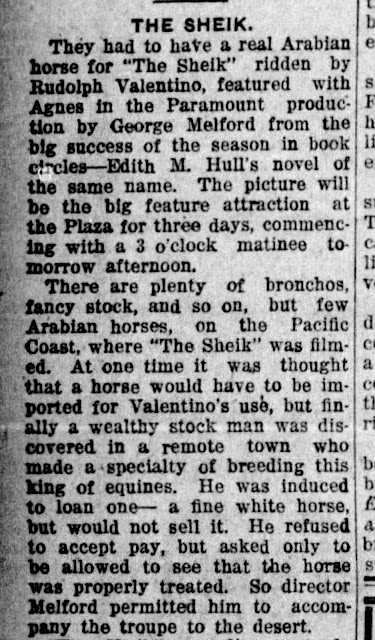
Tampa Bay Times, 20 December 1921

"There are plenty of bronchos, fancy stock, and so on, but few Arabian horses,  on the Pacific Coast, where "The Sheik" was filmed. At one time it was thought that a horse would have to be imported for Valentino's use, but finally a wealthy stock man was discovered in a remote town who made a specialty of breeding this king of equines. He was induced to loan one -- a fine white horse, but he would not sell it. He refused to accept pay, but asked only to be allowed to see that the horse was properly treated. So director [George] Melford permitted him to accompany the troupe to the desert."

So I wondered -- who would have owned purebred Arabians in "a remote town" in California in 1920-1921? F. E. Lewis bred Arabians at his Diamond Bar Ranch in Spadra, near Pomona -- not really a "remote town." Richard Walton Tully bred Arabians in Sierra Madre, just outside Los Angeles. Anita Baldwin bred Arabians in Arcadia, but she was neither "a wealthy stock man" nor did she live in a "remote town." Legendary media baron William Randolph Hearst (not usually identified as a "stock man," although he certainly owned livestock) started breeding Arabians in 1919, but surely a man as busy and wealthy as Hearst did not personally follow a film crew around Oxnard to make sure his horse was okay. Chauncey D. Clarke, who bred Arabians in the Coachella Valley, might have fit the description...

Then I found a photograph of Valentino astride his "Arabian" mount in "The Sheik," and I stopped wondering which Arabian horse it might have been or who owned her. That's because this white horse does not look like an Arabian. Rather heavy and plain, she had a convex profile and a mostly-white coat with a little dark mottling around her ears and along the front of her neck, like a Medicine Hat Pinto. She might have been part Arabian, but there's no way to tell. 

Perhaps her owner knew no better; perhaps he convinced the filmmakers the mare was an Arabian; perhaps "Arabian" simply meant "mostly white horse in a costume." 

Still,  this older mare did her job well in the film. And we do know her name.


anna sheik valentino 1921.jpg
Rudolph Valentino on Anna Not-An-Arabian, 1921

Newspaper accounts name Valentino's mount in "The Sheik" as a reliable mare foaled in 1900, named Anna. I took some screen grabs of Anna and Valentino from a copy of "The Sheik," and a short "Making of The Sheik" film, available online, so we can get another look at her here.


Anna with Rudolph Valentino, right


Anna with Rudolph Valentino, left.

To the people in the movie theaters, Anna's appearance and ancestry probably didn't matter much. Filmgoers in 1921 didn't pay 15 cents to see images of horses racing across the sand at Oxnard Beach; they were there to see Valentino.

Anna is also named in one newspaper article as the horse ridden by Marion Davies in the 1922 silent "When Knighthood Was In Flower." There are five or six white horses in the film; I haven't found any other references to Anna and the "Knighthood" film online. True, Davies was the mistress of W. R. Hearst, but I don't think Hearst ever bred an Arabian that looked like Anna.

Whatever her breeding, Anna seems to have spent most of her career in New York, where she pulled Radames' chariot onto the stage in productions of "Aida" at the Metropolitan Opera for several years before she met Valentino. The gold curtain came down for Anna in 1940, when she died at the age of 39.  The Met Opera folks had a nice memorial service for her. 

Buffalo Evening News, 23 March 1940

The Buffalo Evening News article on her passing said that Anna had also appeared in "Ben-Hur." But what kind of production -- film or stage? 

There don't appear to be any white horses in the 1907 Kalem film production of "Ben-Hur;" Anna would have been 25 years old when the 1925 classic MGM film version of the story was released, so it's unlikely she was used as a chariot horse in the famous racing scene. (More on the 1925 "Ben-Hur" later in this series.)

So if the story is true, Anna must have performed in one of the popular live stage adaptations of General Lew Wallace's "Ben-Hur: A Tale of the Christ" in the early part of the century. Theater audiences were wowed by the sight of running horses pulling chariots on a treadmill on the stage, in front of a revolving backdrop of scenery that gave the impression of forward motion. Stage productions of "Ben-Hur" ran for 18 non-consecutive years on Broadway, and touring companies took the play on the road around the world through 1920.

So -- Anna was a beloved celebrity mare, but not (by all appearances) an Arabian!

***

In Part Two of this series, we'll look at the 1921 silent "Queen of Sheba," the Not- Arabian horses that were promoted as "Arabians," and the performance of one of the 20th century's greatest cowgirls as a stunt rider.
_____________________________________________________


Thanks
Many thanks to Carol Woodbridge Mulder, Tobi Lopez Taylor, Dolores "Dee" Adkins, and Shay Canfield for their invaluable assistance in preparing this series. Information in this post came, in part, from the wonderful W. K. Kellogg Arabian Horse Library at Cal Poly Pomona.

The Sheik (1921)

The Sheik, Behind the Scenes 

Internet Movie Database entry for Rudolph Valentino

Ben-Hur (1907)
A copy of this early adaptation of the story, all 13 minutes of it, is available here:

"Ben-Hur" on stage
There's information on the early theater productions of "Ben-Hur" here:

Arabian Horse History
The US breed registry's history of the Arabian horse is reduced to a PDF you have to search for, on the Arabian Horse Association's youth website... 

...and another PDF on Domestic (US) Arabian bloodlines.


Wednesday, April 17, 2024

Gene Gray, King of the Silver Cowboys and Dixie Gray, Queen of the Silver Saddle


Gene Gray and Don Joaquin

Many Americans of A Certain Age remember that Roy Rogers was "the King of the Cowboys." Southern California horse lovers during the post-World War II years may have also known that Gene Gray was called "the King of the Silver Cowboys."

Silver, as in the over-the-top silver-and-gold-mounted saddle and bridle on his Palomino horse, Don Joaquin.

Eugene Gray (1899-1950) was born in Pennsylvania, but was living in Los Angeles by the time of the 1940 Census. After World War II, he often rode in parades with his wife Dixie, in a similarly ornate silver saddle and trappings. Dixie was promoted as "the Queen of the Silver Saddle."

Dixie's horse is not identified in this photo,
but about the same time other newspaper stories
called her Palomino mount "Silver." (That would make sense.)


And what saddles they were. A local newspaper described them:

"The costumes of  the Grays and trappings of their horses have cost $70,000 and $35,000 each. Each outfit contains 4,200 pieces of hand engraved sterling silver and is ruby- studded. It is reported that no such elaborate outfits were were made for other riders, not even during the elaborate pageantry during the days of knighthood."  [A different newspaper report inflated the value of Gene's saddle set to $120,000.]

San Bernardino County Sun, 12 October 1949

"Dixie Gray...has won thousands of first place trophies stretching all the way from Madison Square Garden in New York to Hollywood's Christmas Tree parade. She has appeared in over 3,400 parades and rodeos. Only last month she won first and overall first in the world championship sheriff's rodeo at Los Angeles, the first woman in history to take this honor."

The Grays rode in several Tournament of Roses Parades in Pasadena, alongside the likes of trick roper Montie Montana, "Wild Bill" Elliott (one of the actors who portrayed Red Ryder in the movies), Monrovia/Duarte horse rancher Merle Little; Ernest, Emelie, and Anna Specht on their stunning Palominos King Cortez, Golden Son Cortez, and Golden Don Cortez; actor and horseman Leo Carrillo, and others. 

When the nature of the event required less bling, Gray and Don Joaquin could appear with "regular" cowboy outfits.

Gray was a regular in local parades and rodeos, with Gene directing several grand entry parades at equestrian events. The Internet Movie Database credits Gene with an appearance as himself in Spade Cooley singing Western "The Silver Bandit," released in 1950.

Gene seems to have been very community-minded. Materials on Ancestry.com show that he and Dixie were somehow involved in the Rancho Sanitarium in Culver City. Gene would donate the services of an ambulance with a horse trailer hitch at regional horse shows. And he supported a short-lived plan to establish the development of an "old-fashioned Western town" called "Rawhide" in the San Fernando Valley, that would have included a non-profit hospital and sanitarium and a Western art museum.

When Gene Gray died suddenly on February 10, 1950, many of his fellow equestrians attended the funeral. Film star and rodeo legend Hoot Gibson served as a pallbearer. Bill "Hopalong Casssidy" Boyd, Roy Rogers, Gene Autry, and Los Angeles County Sheriff Eugene Biscailuz were among the honorary pallbearers. 


The funeral services included his faithful Palomino, Don Joaquin, wearing his full silver tack draped with a black blanket. Noted baritone Stephen Kamalyan sang the Western classic "Empty Saddles."


It was a fitting tribute to a man who spent so much of his time in the saddle. After Gene's passing, Dixie kept riding Don Joaquin in parades for several years. 

The subject of silver-mounted Western saddles deserves its own blog post, so I'll address it in greater depth soon.

***

Bing Crosby sings "Empty Saddles (in the Old Corral)"


Tuesday, April 16, 2024

Horse Show Ambulance at the 1947 Bar-O National Horse Show, San Diego

After World War II, horse shows seemed to proliferate in Southern California. At the estate sale of horsewoman Maggi McHugh, I found several horse show programs that she and her late husband, Mac McHugh, had treasured, from the Annual Bar-O National Horse Shows at the Polo Grounds in San Diego.


The program from the Sixth Annual show, in 1947, featured a photo of something I had not seen before: a specialized horse show ambulance.


Ambulance service is furnished to the Bar-O National Horse Show through the courtesy of Gray's Hospital and Sanitarium, 110 West 59th Place, Los Angeles.

The ambulance is equipped to do minor surgery. A registered nurse is on duty to assist the doctor and to administer first aid. It is equipped with fire extinguishing tanks which spray snow upon the fire. The temperature in the tanks is 135 degrees below zero. It is equipped to pull your horse and trailer to any emergency call. It has eight ply, rayon, airplane tires for speed and safety. This service is offered free of charge to all horse shows and rodeos within a radius of two hundred miles. Just telephone Pleasant 2-7200. 

Emergency Medical Services with trained professional staff were not generally available before the 1970s, so this hospital on wheels with a horse trailer hitch seems to have been a case of a horseman with a hospital finding a need and meeting it. 

Gene Gray, the man who operated the hospital in the San Fernando Valley, was well known in the Southern California equestrian community as the "Silver King of the Cowboys." His wife, Dixie Gray, was known as the "Queen of the Silver Saddle." Here's more information on them:

https://californiahorsehistory.blogspot.com/2024/04/gene-gray-king-of-silver-cowboys-and.html

Monday, April 1, 2024

The Three *Raswans


*Raswan 607 (Skowronek x Rim)

With this post, I hope to shed a little more light on the story of the Arabian stallion *Raswan, who sadly died before he could realize his full potential. It turns out that a young sculptor visited *Raswan at the Kellogg Ranch in April 1926, and captured the horse's image for a  public display. It appears that there are only a few photographs of the sculptures, and as far as I have been able to tell, the sculptures and any sketches or smaller models of the images of *Raswan made by the artist are no longer with us.

In January 1926, cereal magnate W. K. Kellogg sent his stable manager, Carl Schmidt, to the renowned Crabbet Stud in England. Schmidt's mission was to purchase Arabian horses for Kellogg's ranch in Pomona, California. In April, Schmidt returned on the ship Minnewaska with fourteen Arabians and a Welsh Pony stallion. They were transferred from the ship to a Union Pacific train headed for Southern California, arriving in Pomona on April 10.

To indicate they were imported to the US, the horses' registered names included an asterisk ( * ); their American registration numbers follow their names.

The imported herd included four stallions foaled in England and two that arrived in utero and were foaled at the Kellogg Ranch. The four adult horses were:

*Nasik 604 (Rijm x Narghileh), an 18 year old bay 

*Raswan 607 (Skowronek x Rim), a five year old gray 

*Raseyn 597 (Skowronek x Rayya), a three year old gray half-brother to *Raswan

*Rimal 599 (Hazzam x Rim), a bay yearling

*Raseyn and *Nasik became internationally famous sires;*Rimal was gelded and sold. But at the time of the importation, the stallion who showed the most promise for Mr. Kellogg's breeding program was *Raswan. (He had already sired three purebred Arabians in England.)

Equine historian Carol Woodbridge Mulder observed:

A very high quality, beautiful horse of outstanding classic type, he was the better of  the two Skowronek sons....

*Raswan, with Carl Schmidt in "desert garb"

But that promise was never realized. Schmidt and Kellogg had a bitter dispute over who really owned *Raswan. On May 7, 1926, Schmidt rode the horse off the Kellogg property across the hills to an isolated house in Walnut, tying him by his bridle to a fence. *Raswan broke loose and ran into a hay mowing machine in a field, grievously injuring one hind foot. Veterinarians tried to save him, but they ended up having to put *Raswan down on June 12, 1926. (For details of this complex story, please see Mary Jane Parkinson's detailed description in her book Romance of the Kellogg Ranch. Mulder does a good job of summarizing the story in her article "The W. K. Kellogg Arabian Horse Ranch, Part VI -- 1926 Crabbet Purchase Males" in The Crabbet Influence, November-December 1987.)

Sadly, there are very few known photographs of *Raswan, and only one, very short, film clip of him that I could find on YouTube:

https://www.youtube.com/watch?app=desktop&v=Pa6qWvq31JU


*Raswan, in a screen grab from Lonny Hitchens' film clip on YouTube

But that isn't the whole story of *Raswan in California. It turns out that, a couple of weeks after *Raswan arrived at the Kellogg Ranch in April 1926, a young artist sketched him and created three sculptures of *Raswan. And thanks to the resources of Cal Poly Pomona Special Collections' W. K. Kellogg Arabian Horse Library, we can connect the art and the artist to the horse. 

The artist was the renowned California sculptor L. P. (Lorraine Preston) Prescott, later known as Preston L. Prescott (1898-1988). Born in Iowa, Prescott studied art in Minnesota, New York, and Los Angeles. After serving in World War I, Prescott lived at an American Legion post in Southern California for disabled veterans for a few years. Prescott worked in the film industry creating components for movie sets, and creating wax portraits of celebrities. In the 1930s he moved to Ojai, in Ventura County, where he had a well-known art studio, and in 1945 he moved to Ben Lomond, near Santa Cruz in Northern California. Prescott went on to have a distinguished career as an artist and arts educator. 


What's less well-known is Prescott's work creating components for the Los Angeles Chamber of Commerce's massive displays of citrus fruit for local agricultural exhibitions in the 1920s. And that's where the Arabian stallion *Raswan comes in.

In April 1926, the LA Chamber had reached out to the Kellogg Ranch, asking permission for their sculptor to visit the Ranch and make sketches of one of the horses. W. K.'s son, Dr. Karl H. Kellogg, gave his permission for the artist to sketch one of the recent imports: *Raswan.

From the collection of the W. K. Kellogg Arabian Horse Library,
Cal Poly Pomona


April 23, 1926

Los Angeles Chamber of Commerce

Los Angeles, Calif.

Gentlemen:

    I am giving Mr. L. P. Prescott permission to go ahead and make sketch of Arabian horse Raswan, to be used in Grecian exhibit at Anaheim Orange Show.

    Yours respectfully,

    [KHK]

Sometime between April 23 and April 26, Prescott came to the Kellogg Ranch to sketch and model *Raswan.  On the 26th, Chamber Secretary and General Manager Arthur G. Arnoll wrote his thanks to Mr. Kellogg:

From the collection of the W. K. Kellogg Arabian Horse Library,
Cal Poly Pomona

April 26, 1926

Mr. W. K. Kellogg
Box 207, Pomona, California

My dear Mr. Kellogg:
    I want to take this opportunity to express our appreciation for your kindness in allowing our sculptor to make drawings and models of one of your fine Arabian stallions.
    I presume he has told you that the finished product will be used in the Anaheim Orange Show where our exhibit will consist of three white horses hitched to a chariot.
    Again expressing our appreciation, I am
        Yours very truly,
            LOS ANGELES CHAMBER OF COMMERCE 
                (signed) A. G. Arnoll
            Secretary and General Manager


The "Anaheim Orange Show" in the letters was formally known as the Sixth Annual California Valencia Orange Show. It was held in Anaheim from May 13 to 23, 1926.

 I haven't been able to find any evidence that Prescott's drawings and models of *Raswan survived, but there are a few photos of the final result of the artist's time with the stallion. These images show three larger-than-life-sized horses pulling a chariot driven by a mannequin, atop a display of fresh ripe citrus fruit, forming a sort of "orange brick road" for the chariot. 

428457153_10230332353387665_8830028801081696530_n.jpg

The next photo shows us the scale of the sculpture. Ruth Henle, a secretary at a local medical clinic and member of the Anaheim Business and Professional Women's Club, posed next to the three *Raswans in a photo that appeared in a number of Southern California newspapers. (In reality she was Mrs., not Miss, Henle, meaning that she continued to work after her marriage, which was not all that common in the 1920s.)


A full page spread in the 23 May 1926 Los Angeles Times showed just how over-the-top the display entries at the Orange Show were.


Prescott's work, featuring the three *Raswans pulling the chariot, won a major award.


Anaheim Gazette, 20 May 1926

Prescott had to turn around his finished work rather quickly; I haven't found any mention of what medium/media he may have used. The 27 May 1926 issue of  the Anaheim Gazette reported that the three horses were dapple gray (as was *Raswan).


Prescott did another, perhaps more realistic, horse statue for the Chamber; it appeared in the 1928 Valencia Orange Festival in San Bernardino, above an even more impressive display of oranges. But the horse wasn't an Arabian this time. There are two photos of the statue in the Los Angeles Public Library collection. You can see the photos here:  


The caption reads: "L.P. Prescott is sculpting "Joan of Arc" on the Ambassador Hotel grounds.  His model is Mrs. Mildred Perlee ("Aarai"), a dancer, who is posing on Dexter, a light cavalry jumping horse owned by Maj. A.L.P. Sands of the 82nd Field Artillery, Ft. Bliss, Texas."


Here's the near-life-size version of the statue at the San Bernardino Orange Festival display.

428478678_10230332413389165_1658737831756955503_n.jpg

Seeing these images gives us insight into the way Prescott worked in the 1920s. Because the final version of the Chamber's 1926 entry in the Orange Show in Anaheim shows three horses in action, I surmise that Prescott saw *Raswan running at liberty in a paddock or field at the Kellogg Ranch in April 1926, and made "sketches and models" of him on site, as noted in the Chamber's thank-you letter to Mr. Kellogg.

Preston L. Prescott is probably best known today for his statue of the Hugo Reid family. It's currently located on the grounds of the Gilb Museum in Arcadia.

Los Angeles Times, 27 July 1937

Photo by the author


Prescott died in Santa Cruz in 1988. I reached out to the artist's family through an online ancestry site, but they are not aware of any of his papers or drawings that would show us his impressions of *Raswan. (If only...!) 

*Raswan's story is indeed tragic, but I find some solace in knowing that, for the brief period of time when the young artist visited the Kellogg Ranch, *Raswan personified the beauty and grace of the Arabian horse.

___________________________________________________

*Raswan's half-brother *Raseyn was the subject of several works of art. Here's a film clip of sculptor Annette St. Gaudens with *Raseyn at the Kellogg Ranch in 1929.


This smallish headstudy of *Raseyn was created in 1934 by Lawrence Tenney Stevens. It's part of the collection of the W. K. Kellogg Arabian Horse Library.


The young Gladys Brown (later Edwards) painted *Raseyn, also in 1934.


* * * 

A print of the photograph of Ruth Henle next to the chariot is in the UCLA Library, Special Collections department: 

* * * 
In 1927, Carl Schmidt had his name legally changed to Carl Raswan.

Los Angeles Times, 8 February 1927


As always, thanks to Tobi Lopez Taylor for her editorial assistance in preparing and editing this post. Her own blog is here: 


Many thanks to the staffs of the W. K. Kellogg Arabian Horse Library at Cal Poly Pomona: 


and the Gilb Museum of Arcadia History: 


for providing materials I reviewed for this post.